



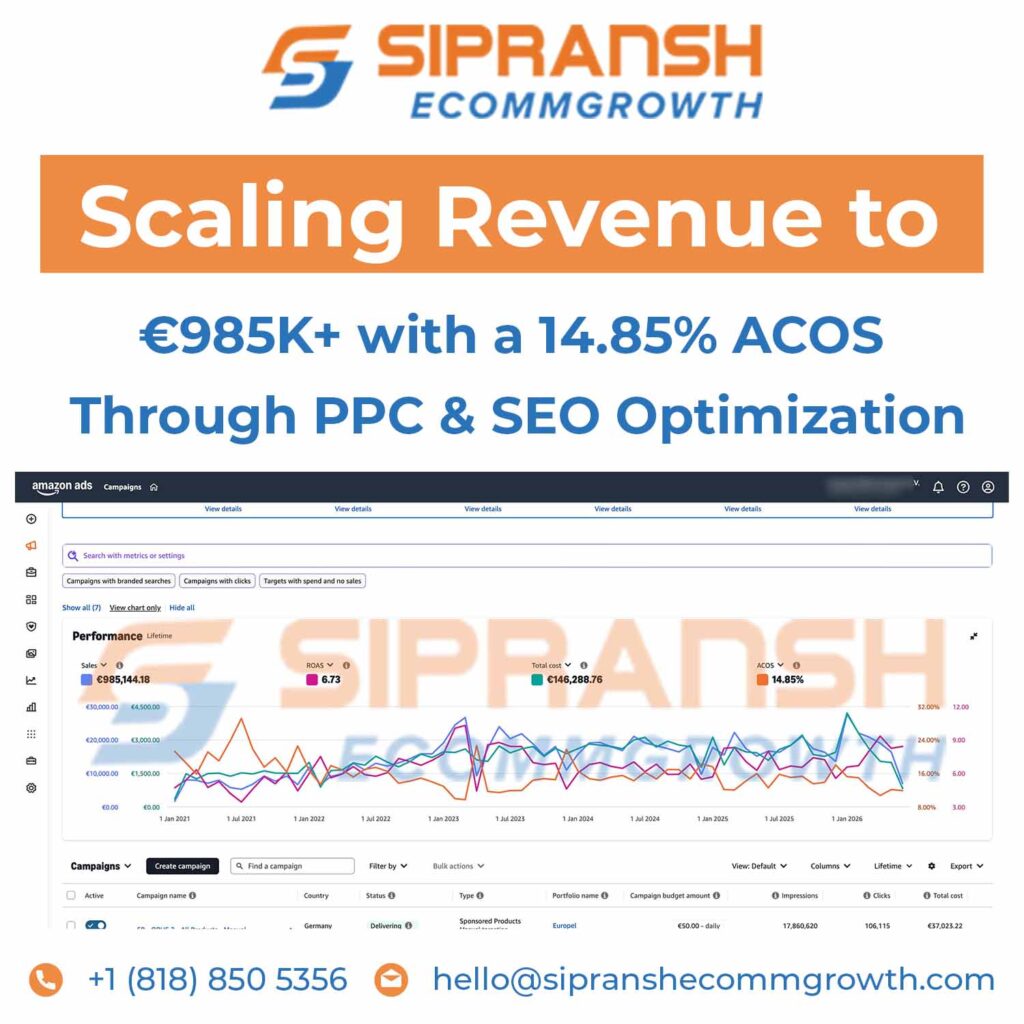
The client operates in multiple European Amazon marketplaces and approached us to improve overall account performance, advertising efficiency, organic visibility, and long-term profitability.
At the beginning of our engagement, the account had strong growth potential but required a more structured advertising strategy, keyword expansion, Amazon Product listing optimization, and continuous Amazon account management to unlock scalable growth.
As a full-service Amazon marketing agency, our involvement extended across:
For this case study, we will focus specifically on the PPC and SEO results.
Based on the account performance data:
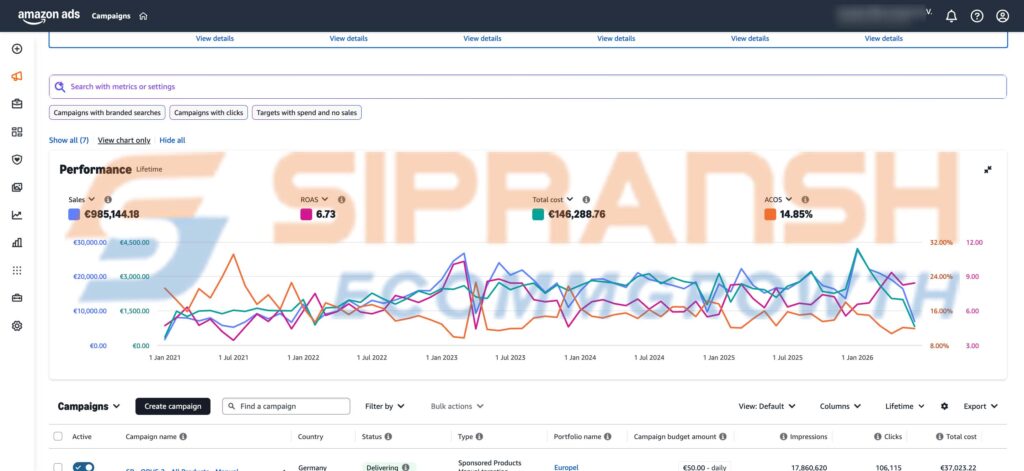
€985,144.18
€146,288.76
6.73
14.85%
These numbers demonstrate a highly efficient advertising structure where every €1 spent on advertising generated approximately €6.73 in sales revenue.
Maintaining an ACOS below 15% while scaling towards €1 million in attributed sales is a strong indicator of profitable growth and mature campaign management.
When we initially started managing the account, several areas were limiting growth:
Campaigns were not fully segmented according to search intent, keyword performance, and product priorities.
As a result:
Several products were not ranking consistently for high-volume search terms.
This caused:
The account was not fully targeting the complete customer search journey.
Important opportunities existed within:
Even when traffic was reaching the listings, there were opportunities to improve conversion rates through better SEO implementation and listing optimization.
We conducted a comprehensive audit of:
This allowed us to identify where advertising spend was generating the highest returns and where inefficiencies existed.
We rebuilt the PPC architecture using a structured approach.
Campaigns were segmented by:
Match Types
This allowed us to:
Products were grouped according to:
This ensured advertising budgets were aligned with business objectives.
One of the most impactful activities involved continuous search term analysis.
Every week, we reviewed:
This process allowed us to:
Instead of applying generic bidding strategies, we optimized bids based on:
This helped maintain profitability while increasing visibility.
We continuously monitored:
Budget and bid adjustments were made according to placement-level profitability.
This increased visibility in premium placements while protecting advertising efficiency.
While PPC generated immediate traffic, SEO was used to build sustainable long-term growth.
We conducted extensive keyword research focused on:
Keywords with significant search demand.
Search terms with strong purchase intent.
Terms driving traffic to competing products.
Lower-competition phrases with higher conversion potential.
Every major listing element was optimized.
Titles were rewritten to include:
Without compromising readability.
Bullet points were optimized to:
Hidden keyword fields were strategically utilized to maximize indexing opportunities.
Descriptions were enhanced to improve:
By combining PPC and SEO strategies, products gained stronger organic positions for important search terms.
This produced several benefits:
As rankings improved, products generated more organic traffic.
Organic sales contributed to overall revenue without increasing advertising spend.
Products became more visible across multiple search results pages.
One of the key reasons for success was the integration of PPC and SEO rather than treating them as separate activities.
The PPC campaigns generated valuable keyword data.
We then used this data to:
As organic rankings improved, PPC efficiency also increased.
This created a positive growth cycle where both channels strengthened each other.
The account generated:
€985,144.18 in Amazon-attributed sales
through carefully managed advertising campaigns.
Despite scaling sales significantly, we maintained the following:
14.85% ACOS
which indicates highly controlled advertising costs.
The account achieved:
6.73 ROAS
meaning every €1 invested generated approximately €6.73 in sales.
Rather than focusing on short-term spikes, the account was built around a sustainable growth framework that continued delivering performance over an extended period.
The account expanded visibility across a larger set of relevant search terms, increasing both paid and organic traffic opportunities.
Campaign budgets were continuously redistributed toward high-performing keywords and products, improving overall account efficiency.
Through a combination of advanced Amazon PPC management and strategic SEO optimization, we transformed the account into a highly efficient revenue-generating asset.
The result was:
By continuously optimizing campaigns, refining keyword strategies, improving listing relevance, and leveraging data-driven decision-making, we created a scalable system capable of delivering long-term profitable growth across Amazon European marketplaces.
This case study demonstrates how a structured PPC and SEO strategy can drive significant revenue growth while maintaining strong advertising efficiency and profitability.