


When a trusted brand in the baby care market saw its Baby Breastfeeding Weaning Balm Stick removed from Amazon due to a product policy compliance issue, the business faced a critical setback.
For a brand highly reliant on Amazon’s reach, the delisting paused sales. It also risked losing valuable market positioning and customer trust. Sipransh Ecommgrowth stepped in with a comprehensive restoration strategy. This included listing reinstatement, ad spend optimization, and sales performance improvement.
By systematically rebuilding their Amazon presence, we reestablished their market foothold. As a result, we achieved a significant decrease in ACoS and a steady increase in sales. This turned a major setback into a growth opportunity.
This case study explores the steps we took to restore the business. It also highlights how we surpassed their previous performance and delivered results beyond expectations.
<span style=”font-weight: 400;”>
Challenges:
1. Loss of Social Proof: Starting with zero reviews after having 2,000 positive reviews can significantly impact credibility and conversion rates, especially in the sensitive baby care category where reviews play a pivotal role in customer trust.</span></p>
2. High ACOS on New PPC Campaigns: Without reviews, PPC campaigns typically require higher bids to achieve visibility and engagement, which can initially inflate
the ACOS. For niche products like weaning balm, reaching a stable, profitable ACOS can be a slower process.
3. Product Policy and Compliance Monitoring: The baby care category often has stringent compliance requirements. Ensuring that product descriptions, keywords, and images fully align with Amazon’s policies is crucial to avoid future listing removals.
4. Sensitive and Specific Audience: Weaning balm appeals to a niche market of breastfeeding mothers, making audience targeting critical. However, PPC targeting can be challenging without reviews or brand recognition, and the product must reach the right audience to avoid wasted ad spend.</p>
5. Compliance with Health and Safety Regulations: Being part of the baby care category, the product is subject to strict regulations, which can cause frequent scrutiny and potential compliance-related suspensions.
6. Restoring Organic Ranking: Once a listing is reactivated, organic ranking and visibility need to be rebuilt from scratch, which can be time-consuming and requires consistent PPC and SEO efforts to regain lost ground.
1. Launching Targeted PPC Campaigns: We started with a comprehensive PPC strategy on the new listing to regain visibility. Despite zero reviews, we targeted high-converting keywords from the previous listing to capture relevant traffic. Initially, ACoS was above 30%. However, continuous optimization refined targeting and ad placements, significantly lowering ACoS over time.
2. Keyword Optimization for High Organic Ranking: To accelerate organic ranking recovery, we incorporated previously high-performing keywords into the title, bullet points, and backend search terms. This on-page optimization helped regain first-page rankings. As a result, organic visibility improved without heavy reliance on ads.
3. Bid and Budget Adjustments: We monitored campaign performance daily and adjusted bids to target profitable placements. This reduced ad costs while maintaining visibility. By refining bids, we brought ACoS down from 30% to below 20%, aligning with the client’s goals.
4. Enhanced Content and Review Strategy: We leveraged A+ Content to increase conversions despite the absence of reviews. We used lifestyle images and benefit-focused descriptions to build trust. As a result, CTR and conversions remained stable even in the early stages.
5. Review-Building Campaigns: To quickly gain new reviews, we enrolled the product in Amazon’s Early Reviewer Program and strategically reached out to previous customers within Amazon’s guidelines. This approach helped restore the product’s credibility, reinforcing our PPC efforts and reducing ACOS as conversions increased.
6. Competitor and Negative Keyword Targeting: To further enhance efficiency, we targeted competitor listings directly and used negative keywords to exclude irrelevant search terms, minimizing wasted spend and focusing only on high-intent keywords. This targeting helped stabilize ACOS and improved ROI.
7. Weekly Performance Analysis and Adjustments: We conducted weekly reviews of PPC metrics and organic ranking positions, adjusting our strategy as needed. This proactive approach ensured that campaigns stayed optimized, maintaining the balance between ad spend and organic growth, and ultimately achieving ACOS below 20%.
Through these focused actions, we successfully restored the product’s standing on Amazon and achieved the client’s goal of reducing ACOS to below 20%.
You don’t need to rewrite everything—just break a few long sentences into tighter ones. Here’s a cleaner version that should pass readability checks:
Targeted PPC campaigns boosted the product’s visibility on relevant keywords from the start. This ensured it reached the right audience, even with zero initial reviews. As a result, the increased visibility drove early traffic and set the stage for organic growth.
ata-start=”417″ data-end=”634″>By optimizing the listing with high-impact keywords, the product quickly reclaimed its first-page positions. This reduced dependency on ads. It also allowed for more organic sales, which are cost-free compared to PPC.
ata-start=”636″ data-end=”887″>Systematic bid adjustments reduced ad spend without compromising visibility. As a result, ACoS improved and aligned with the client’s profitability goals. Efficient spending also created more budget flexibility to explore additional growth strategies.
Using Enhanced Brand Content created a professional, trustworthy brand image, which appealed to shoppers and encouraged conversions even before significant reviews had accumulated. This optimized content helped establish the product as a go-to choice for the target audience.
The Early Reviewer Program helped reestablish social proof, crucial for increasing customer trust. By quickly gaining verified reviews, the product gained traction faster, which further supported conversion rates and ad performance.</p>
Competitor targeting and negative keywords optimized ad relevance, reducing costs associated with irrelevant clicks and ensuring the product appeared in front of the most likely buyers, which enhanced ROAS.
Weekly analysis enabled agile adjustments, keeping the PPC strategy aligned with real-time performance and market changes. This approach helped maintain low ACOS and high conversion rates, supporting both profitability and sustainable growth.</p>
These actions collectively increased both paid and organic visibility, built customer trust, and enhanced profitability, positioning the product strongly on Amazon while achieving the client’s target ACOS.</p>
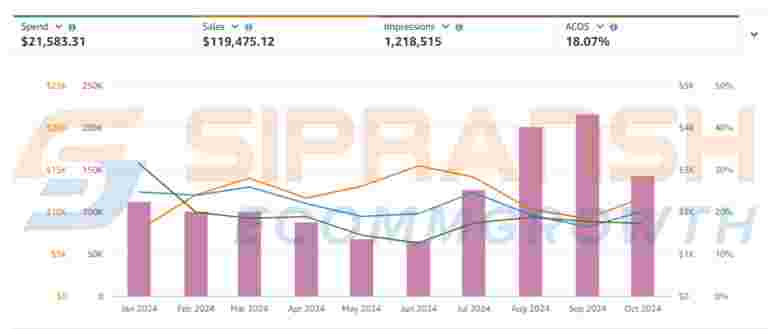
optimization techniques. Notably, the lowest ACoS reached 12% in one of the months. In addition, we regained lost sales and reviews while optimizing the listing in strict compliance with Amazon’s guidelines.
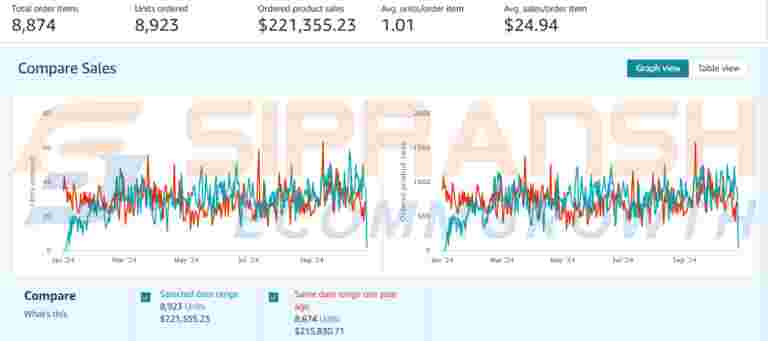
During the period from January 1st, 2024 to October 25th, 2024 (10 months), performance results were as follows:
To begin with, total units ordered reached 8,923 units.
>Furthermore, total ordered product sales amounted to $221,355.
>Meanwhile, organic sales contributed $101,880.
>At the same time, PPC sales generated $119,475.
>Moreover, PPC spend was controlled at $21,583, maintaining an ACoS of 18%.
>Finally, PPC impressions reached 1,218,515.