



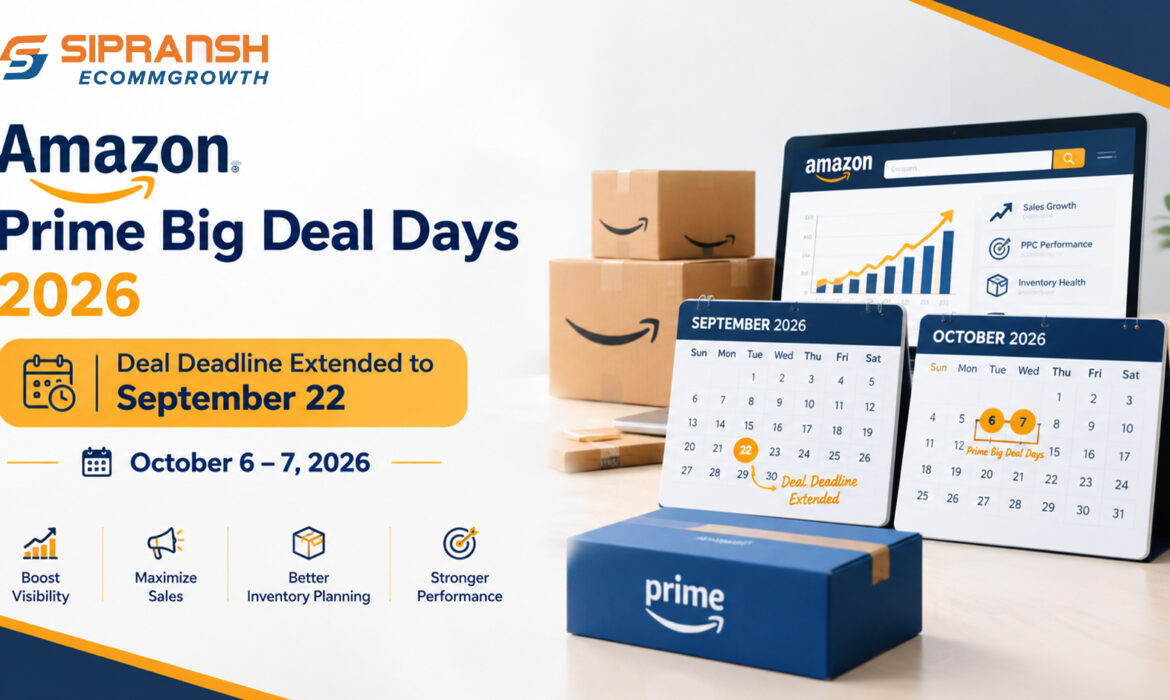
Amazon sellers have received a little more time to prepare for one of the major shopping events of Q4 2026.
Amazon has extended the deal-submission deadline for Prime Big Deal Days 2026 to September 22, 2026. The shopping event is scheduled for October 6–7, 2026.
For brands that were still finalizing their promotional strategy, the extension creates an additional opportunity to review eligible products, inventory, pricing, advertising budgets, and listing readiness before committing to deals.
However, the additional time should not be viewed simply as an opportunity to add more discounts. Sellers should use these final days to determine which products can actually support increased traffic and promotional pressure.
The key dates sellers should keep in mind are:
Amazon’s announcement includes promotional formats such as Best Deals, Lightning Deals, Prime Exclusive Discounts and coupons, subject to the relevant eligibility requirements and submission timelines in Seller Central.
The September 22 extension does not automatically mean that inventory receiving deadlines have also moved. Sellers should continue checking their Seller Central account for the fulfillment requirements applicable to their products.
The extension gives sellers additional time to revisit products that may have been left out of the original promotional plan.
But more time does not necessarily mean that every ASIN should be added to the event.
Before submitting a deal, evaluate each product across four areas:
A product may have strong historical sales but still be unsuitable for a major promotion if the discount significantly reduces contribution margin or available inventory is insufficient.
Start by creating a shortlist of products that can realistically benefit from additional event traffic.
Look for ASINs with:
At the same time, identify products that should not be aggressively promoted.
For example, an ASIN with limited stock and long replenishment lead times may run out during the event. Similarly, a product with weak conversion may simply consume advertising budget without generating sufficient incremental sales.
One of the biggest mistakes sellers can make during a major Amazon event is focusing on revenue without calculating what remains after the promotion.
Your promotional calculation should consider:
For example, if a promotional order leaves $10 before advertising and your business requires $4 of contribution after advertising, the remaining advertising allowance is $6 per order.
This is only an illustrative calculation. Your actual allowable advertising cost should be based on your product economics and business objectives.
The objective is not simply to generate more orders. It is to understand whether the additional orders create commercially useful results.
A successful promotion can create an operational problem if inventory is not prepared.
Before September 22, review:
Do not automatically treat inventory in transit as guaranteed event inventory.
You should also think beyond October 6–7.
If an ASIN sells significantly more units during Prime Big Deal Days, will enough inventory remain for November and December?
A strong October performance followed by an out-of-stock position during Black Friday or the holiday period can create a very different Q4 outcome.
Driving more traffic to an unprepared product page can make advertising less efficient.
Before the event, review your:
Customers arriving from deals and advertisements still need to understand the product quickly.
Your listing should clearly communicate:
What is the product?
Who is it for?
What problem does it solve?
Why should the customer choose it over alternatives?
What value does the promotional price provide?
A discount can encourage the click, but the product detail page still has to support the purchase decision.
Prime Big Deal Days should not be treated as a normal advertising period.
Higher traffic can create additional opportunities, but increased competition can also affect CPCs and advertising efficiency.
Before the event, review:
Separate campaigns can also be useful for products with different objectives.
For example:
Growth products:
Focus on profitable sales and customer acquisition.
High-inventory products:
Use the event to increase sell-through where the economics support it.
Clearance products:
Use a predefined spending and recovery target rather than treating them like normal growth campaigns.
One of the advantages of preparing before the event is that your team can establish decision rules in advance.
For example, define when you will:
This prevents the team from making purely reactive decisions when traffic and order volume increase.
Prime Big Deal Days takes place early in Q4, so sellers should consider the wider holiday calendar.
Before committing inventory and discounts, estimate how the event could affect:
Amazon has stated that promotional prices from the event are excluded from the specified lookback calculation used for maximum deal prices for Black Friday Week and Cyber Monday. Sellers should nevertheless review the applicable requirements and pricing rules in Seller Central before planning later promotions.
Use the following checklist before the September 22 deadline:
The deadline extension should be used for better preparation rather than simply more promotions.
Start with your ASIN-level economics.
Then connect:
Deal → Margin → Inventory → Listing → PPC → Q4 strategy
When these elements are planned together, sellers can make more informed decisions about which products deserve additional promotional exposure.
Prime Big Deal Days 2026 represents an important early-Q4 opportunity for Amazon sellers, but participation should be based on product economics and operational readiness.
With the deal deadline extended to September 22, 2026, sellers have additional time to review their promotional plans before the event on October 6–7.
Use the extra time to identify your priority ASINs, verify inventory, calculate promotional profitability, strengthen product listings and prepare PPC campaigns.
The goal should be to enter Prime Big Deal Days with a clear plan—not simply a larger discount.
Need help preparing your Amazon account for Q4? Sipransh Ecommgrowth provides Amazon account management, Amazon listing optimization, Amazon PPC support, catalog management, and marketplace growth services for brands selling on Amazon.
Learn more at Sipransh Ecommgrowth.